Monday, October 14, 2013

Justice Robert M. Duncan: Legal Trailblazer


Justice Robert M. Duncan
Portrait of the late Ohio Supreme Court
Justice Robert M. Duncan
Occasionally we are able to celebrate someone who has made a tremendous difference in the lives of many. Justice Robert M. Duncan was such a man. On October 10, in an official session of the Supreme Court of Ohio at the Thomas J. Moyer Ohio Judicial Center, the late justice’s family presented to the court his life-like portrait by Toledo artist Leslie Adams.  

The dedication ceremony was very personal and inspiring and can be seen here in our video archive. Chief Justice Maureen O’Connor noted that Justice Duncan was a man of many “firsts.” He was the first African American to serve on the Ohio Supreme Court, the first to win a seat in a statewide Ohio election and the first to be appointed to the federal bench in Ohio. He presided over the case that, in a legal first, ordered the desegregation of Columbus schools. He was a true legal pioneer, blazing a trail for others.

The speakers at the portrait dedication noted Justice Duncan’s illustrious public service career, his generosity, and his love of life. And his family spoke of him with moving devotion.  

Although he ended his judicial career in 1985, Justice Duncan continued to contribute to the legal profession and his community until his death in November of last year. Through his service on the bench and in the community, Justice Duncan was a model for all who aspire to public service. We will be reminded of him by his portrait, which will hang in the Moyer Judicial Center.


Thursday, October 10, 2013

On the Road Again

In just a few weeks, the seven justices of the Ohio Supreme Court will travel for the fall session of our Off-Site Court Program, where twice per year we convene in official session at a location outside Columbus. This will be our 67th trip since the program was started by the late Chief Justice Thomas J. Moyer in 1987.

Crawford County will be our host on October 23 when we hear oral arguments in three cases beginning at 9 a.m. at Bucyrus High School. This is a chance for students to discover how different appellate cases are from the typical TV court portrayals of justice in action.

Students and teachers from Bucyrus, Buckeye Central, Colonel Crawford, Crestline, Galion, and Wynford high schools received curriculum material beforehand, including summaries of the cases that will be argued. Volunteer local attorneys worked with the educators at each participating school to explain Ohio’s judicial system and help review the case materials. The preparation for the event is truly a team effort! 

On Wednesday morning, we justices will meet with the students for a question-and-answer session before the first scheduled argument. First, Chief Justice O’Connor introduces each justice who then has a moment to talk. I usually mention the 5 important skills that we need to properly do our jobs as judges: the ability to listen, read, think, write and speak – skills that continue to be developed in high school and beyond. Then at question time these young men and women can show their curiosity about their state court system. 

After attending oral arguments, students will meet with the case attorneys for a debriefing and discussion of the legal issues in the case they just heard. Generally, this is the favorite portion of the event for all involved.

You can find more information online about the Supreme Court Off-Site Court Program as well as a video showing footage from past sessions. We are looking forward to being in Crawford County.

Tuesday, October 8, 2013

iCivics Teachers Council Needs You

How would you like to be a part of a national effort to create free, innovative educational materials to reverse our young peoples’ declining civic knowledge and participation?

Former U.S. Supreme Court Justice Sandra Day O’Connor’s iCivics program is accepting applicants for its Teachers Council, to help with teacher engagement and product development.

In four years, iCivics has produced many educational video games as well as vibrant teaching materials that have been used in classrooms in all 50 states. It offers the nation’s most comprehensive, standards-aligned civics curriculum that is available freely on the Web.

By becoming a member of the council, you’ll receive many benefits, including:
  • A letter of commendation from Justice O'Connor sent directly to your administration.
  • A press release in your local community upon acceptance to the Council. 
  • Access to an all expenses paid meeting in Washington, D.C. with fellow Council Members, iCivics staff, education and technology leaders, and Justice O'Connor as her schedule permits.
  • And much, much more.
  • Read the instructions / FAQs, then download the fillable PDF application.
  • Attach the completed application and the 3 other required documents (outlined in the instructions) to teacherscouncil@icivics.org by October 18 at 5 p.m. EST. 
  • Share this link with your teacher friends!
Teachers and anyone passionate about serving teachers may apply, including nonprofit directors, library and media specialists, and curriculum specialists. Instructions and the application are available online, with the application due by October 18 at 5 p.m. EST.

Monday, September 30, 2013

A Dead Language Helps Keep Law Alive


When I was in high school, I studied Latin for four years, never realizing that it would be a help to me when I later studied law. If you follow the Ohio Supreme Court on our website, you may occasionally encounter phrases that come from this “dead language.” Here are just a few examples:
  • amicus curiae = “friend of the court,” a person or entity who is not party to a court case ut who petitions the court or is requested by the court to file a brief because of a special interest in the subject of the case.
  • et al. = “and others,” an abbreviation usually used after the first  name, “Smith et al. v. Jones, et al.” used when there are many parties on one side of the case or another. 
  • ex post facto = “after the fact,” referring  to a law that makes punishable an act that was not illegal at the time it was committed.
  • habeas corpus = “you have the body,” a petition by a prisoner challenging an illegal commitment and seeking a writ that will order release from custody. 
  • nolle prosequi = “unwilling to proceed,” a decision by a prosecutor to dismiss a criminal case.
  • per curiam = ”through the court,” an opinion of the court not signed by a particular justice as an author.
  • pro se = “for oneself,” meaning a person is acting on his or her own behalf without a lawyer.
  • res judicata = “a matter judged,” an issue that already has been settled by judicial decision.
  • stare decisis = “to stand by that which is decided,” principle that precedent is to be followed in later cases.
Even though some would abolish all Latin in court documents, calling for “plain English,” certain phrases are well-established in the American legal system and will continue to be used within the profession by lawyers and judges as a kind of “shorthand” to describe legal concepts and principles. Latin still lives.

Tuesday, September 17, 2013

September 17 is a Special Day for Our Country


On this day in 1787, the U.S. Constitution was adopted by 39 delegates to the Constitutional Convention in Philadelphia.


U.S. Constitution (National Archives Website)
The U.S. Courts’ website has resources for teachers and the general public to learn more about the Constitution. The site includes a quiz to test your knowledge about this vital document that established the foundation of our government. For example, when was the last time the Constitution was amended? I won’t give away the answer. See for yourself and then let me know how you did.

Thursday, September 5, 2013

Once Again, An Open Invitation


I have the distinct pleasure of working in one of Ohio’s most stunningly beautiful buildings. With its architectural and artistic details, the Thomas J. Moyer Ohio Judicial Center, nestled along the banks of the Scioto River in downtown Columbus, is truly a gem.

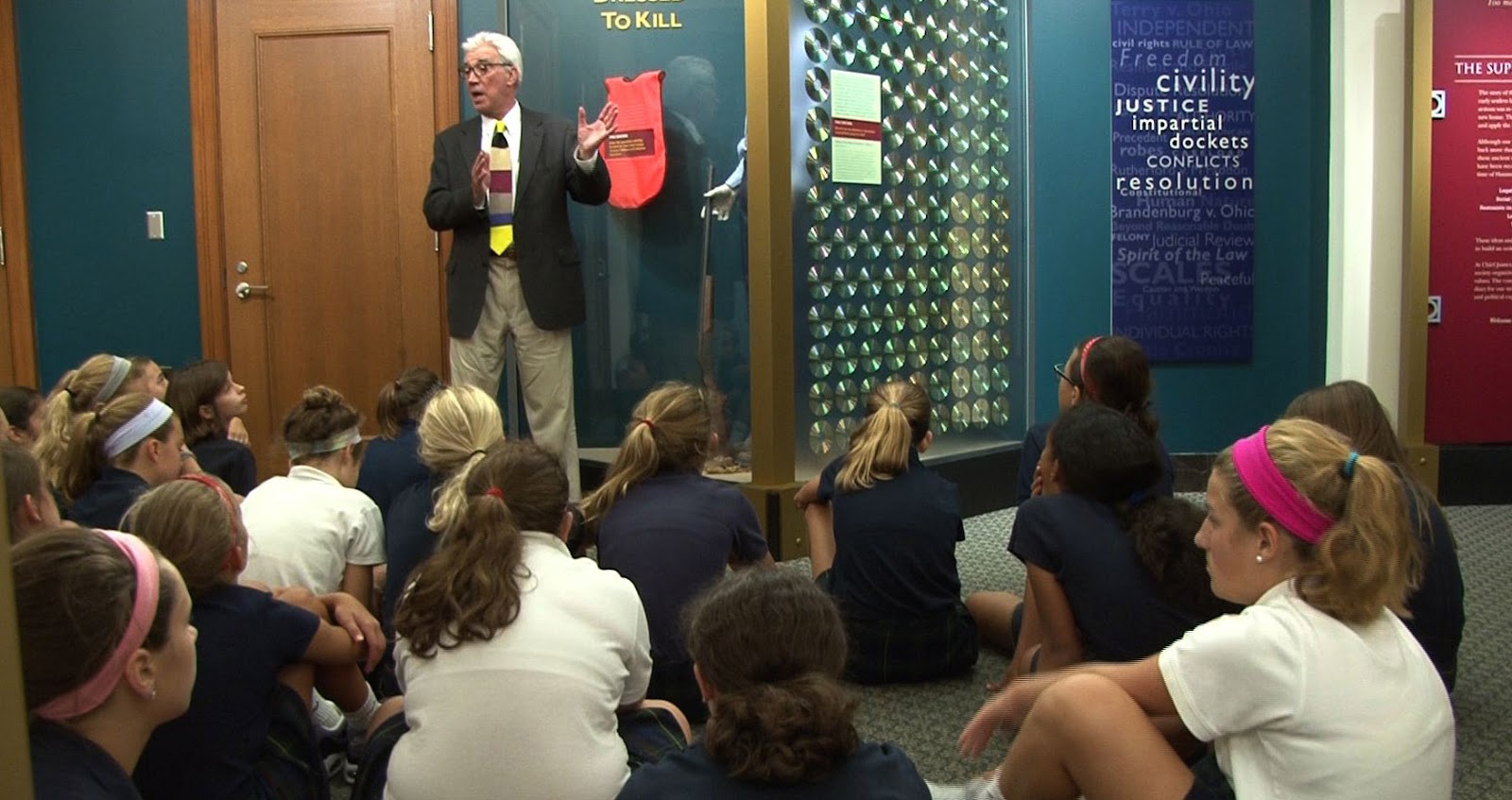
Every year, we have thousands of visitors who tour the building and discover interesting facts about its 80-year history. Part of the tour includes a stop in the Visitor Education Center, where interactive exhibits explain the role of our courts and illustrate important cases and issues. One of my favorite stops is the mock trial courtroom where visitors can place themselves in the roles of judge, jury, plaintiff, and defendant.

We welcome those that we serve, this is your Supreme Court, after all. You can schedule your visit Monday through Friday, 9 a.m. to 4 p.m., by calling 614.387.9223 or e-mailing courttours@sc.ohio.gov.


Hundreds of students expected to visit the Thomas J. Moyer Ohio Judicial CenterWatch this new video to get an idea of what you’ll see during the tour and how one school in Cincinnati is always the first to visit each school year.

Friday, August 16, 2013


Summer Recess is Over


For many Ohio schools, a new year has begun, or will soon. The Supreme Court of Ohio also has been on its summer recess — its break from hearing new cases. But the recess ends next week when we justices are to hear oral arguments in eight cases.
Courtroom of the Supreme Court of Ohio
at the Thomas J. Moyer
Ohio Judicial Center

We hear a variety of cases. Some come to us automatically and some are accepted as cases of  general or public interest.  Some have questions arising under the Ohio or U.S. Constitutions.  Others are cases in which two or more courts of appeals have issued conflicting opinions. From late August every year until June, oral arguments are scheduled for Tuesday and Wednesday mornings on the cases that the lawyers have briefed.

The lawyers for each side have 15 minutes to argue their positions. Each of the seven justices may ask questions at any time, and often a dynamic exchange occurs about the facts or law of the case being argued. The attorneys are signaled when they’re getting low on time: a yellow light signals that there are two minutes left, and a red light signals stop. The same morning after a case is argued, we deliberate and a justice is assigned to write the decision, in the form of an opinion, for the court. On average, an opinion is published within four to five months. 
 
I encourage you to watch streaming video of the arguments available through the Ohio Channel. It’s a great way to see your judicial system in action. You can then read the published opinion on our website, www.sc.ohio.gov.