Tuesday, September 17, 2013

September 17 is a Special Day for Our Country


On this day in 1787, the U.S. Constitution was adopted by 39 delegates to the Constitutional Convention in Philadelphia.


U.S. Constitution (National Archives Website)
The U.S. Courts’ website has resources for teachers and the general public to learn more about the Constitution. The site includes a quiz to test your knowledge about this vital document that established the foundation of our government. For example, when was the last time the Constitution was amended? I won’t give away the answer. See for yourself and then let me know how you did.

Thursday, September 5, 2013

Once Again, An Open Invitation


I have the distinct pleasure of working in one of Ohio’s most stunningly beautiful buildings. With its architectural and artistic details, the Thomas J. Moyer Ohio Judicial Center, nestled along the banks of the Scioto River in downtown Columbus, is truly a gem.

Every year, we have thousands of visitors who tour the building and discover interesting facts about its 80-year history. Part of the tour includes a stop in the Visitor Education Center, where interactive exhibits explain the role of our courts and illustrate important cases and issues. One of my favorite stops is the mock trial courtroom where visitors can place themselves in the roles of judge, jury, plaintiff, and defendant.

We welcome those that we serve, this is your Supreme Court, after all. You can schedule your visit Monday through Friday, 9 a.m. to 4 p.m., by calling 614.387.9223 or e-mailing courttours@sc.ohio.gov.


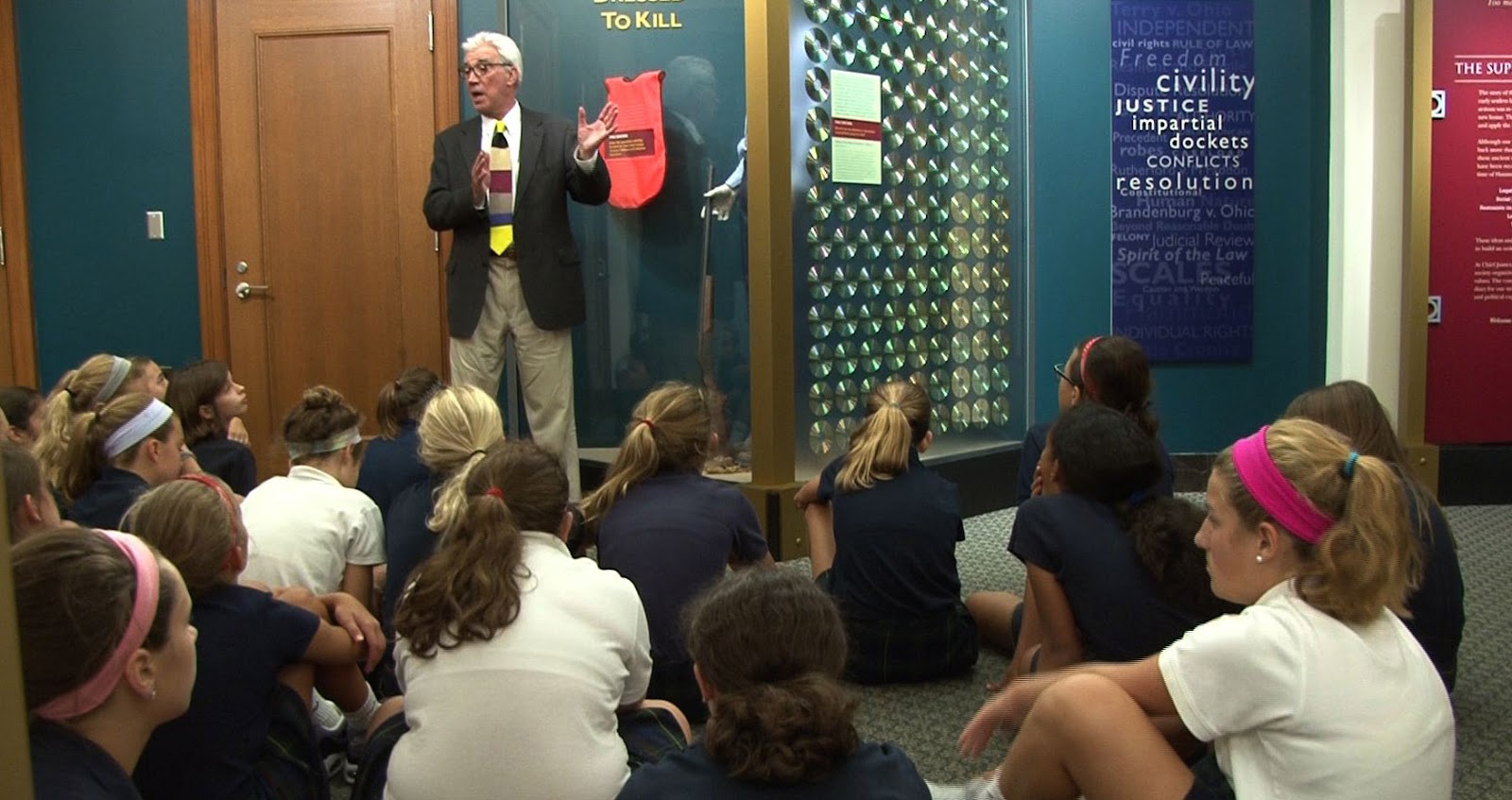
Hundreds of students expected to visit the Thomas J. Moyer Ohio Judicial CenterWatch this new video to get an idea of what you’ll see during the tour and how one school in Cincinnati is always the first to visit each school year.

Friday, August 16, 2013


Summer Recess is Over


For many Ohio schools, a new year has begun, or will soon. The Supreme Court of Ohio also has been on its summer recess — its break from hearing new cases. But the recess ends next week when we justices are to hear oral arguments in eight cases.
Courtroom of the Supreme Court of Ohio
at the Thomas J. Moyer
Ohio Judicial Center

We hear a variety of cases. Some come to us automatically and some are accepted as cases of  general or public interest.  Some have questions arising under the Ohio or U.S. Constitutions.  Others are cases in which two or more courts of appeals have issued conflicting opinions. From late August every year until June, oral arguments are scheduled for Tuesday and Wednesday mornings on the cases that the lawyers have briefed.

The lawyers for each side have 15 minutes to argue their positions. Each of the seven justices may ask questions at any time, and often a dynamic exchange occurs about the facts or law of the case being argued. The attorneys are signaled when they’re getting low on time: a yellow light signals that there are two minutes left, and a red light signals stop. The same morning after a case is argued, we deliberate and a justice is assigned to write the decision, in the form of an opinion, for the court. On average, an opinion is published within four to five months. 
 
I encourage you to watch streaming video of the arguments available through the Ohio Channel. It’s a great way to see your judicial system in action. You can then read the published opinion on our website, www.sc.ohio.gov.

Friday, August 9, 2013

FLASH - for OHIO Teachers!

We were given this information on short notice, but the iCivics program is looking for teachers to give input to help design a new product. The curriculum team and developers from Filament Games are hosting an asynchronous focus group via Google Docs. The feedback would be a written-form focus group that gives you a new set of questions to ponder each day and engage with other teachers. Instead of a video conference, you would just comment on the questions throughout the week.

The goal of the questions is to look at how you overcome classroom challenges, and how iCivics can help you with those problem areas. Teachers would only spend about 15 minutes a day from August 13-16.

Please RSVP to Carrie Ray-Hill at carrie.hill@icivics.org by Monday, August 12 with your preferred email address if interested. And feel free to share with other teachers who you think might be interested.

Tuesday, August 6, 2013

Back to (Law) School

Ohio students at all levels will be heading back to their classrooms this month, and law students are no exception. 

Some people may like to know what it takes to become a lawyer in our state.  First, of course, a person needs to have a high school diploma, and then a college bachelor’s degree before being eligible to enter law school.  But unlike doctors who might have to take pre-med studies in college, “pre-law” courses are not required.  Instead, before being accepted into law school, applicants must take the Law School Aptitude Test, known as the LSAT. A good score and good undergraduate grades make it more likely that a law school will accept someone.
Ohio has nine law schools and soon deans and professors will tell their incoming 2013 class members what to expect.  At most law schools, students will complete the program in at least three years of full-time study.  Upon graduation they receive a Juris Doctor (JD) degree. But that isn’t the end of their studies.
The final hurdle to practice as an attorney is a three-day bar exam administered twice a year in Columbus by the Ohio Supreme Court.  This year, on July 30, 31, and August 1, more than 1,000 aspiring lawyers took the exam.  Now they are waiting for the results and will find out on October 25 if they have passed the bar.  Then, assuming all the other requirements are met, they will be sworn in as attorneys-at-law in the state of Ohio during a special session of our court. 
And active lawyers continue their studies afterwards.  To keep their licenses, they must complete 20 hours of continuing legal education every two years to keep up-to-date in legal practice. 
So you see that the study that law school begins never really ends.  The requirement for life-long learning is just one of the reasons law is a profession.

Wednesday, July 3, 2013

John Marshall’s Legacy of Independence

On every Fourth of July, Independence Day,  we celebrate what makes the United States of America different from other countries.  200 years ago the fourth Chief Justice of the U.S. Supreme court, John Marshall, was appointed by President John Adams.   For 34 years he headed the nation’s federal judiciary, which helps insure our independence.

Marshall was a member of the U.S. House of Representatives and was Secretary of State before being appointed Chief Justice.  He served during seven different presidential terms, dying in 1835 during Andrew Jackson’s second term.  He still holds the record for longest serving Chief Justice.

Before Chief Justice Marshall’s term , the Supreme Court was considered a minor part of the government.  Marshall not only made the judicial branch co-equal to the two other branches , as it is today, but he also presided over a case that announced the Supreme Court’s  authority to overrule the executive branch, legislative branch, states, and lower courts, when necessary.

In the significant case of  Marbury v. Madison, decided in 1803, the Supreme Court said that the U.S. Constitution is the supreme law of the land and that conflicting laws cannot be enforced. The Marshall court clarified that federal law supersedes state law, and that the Supreme Court is the federal court of last resort.  Marshall wrote opinions about the meaning of  ‘commerce’ in the Constitution, the protection  of private institutions from state interference, and explained that the Bill of Rights applied to states as well as the federal government.  These cases remain some of the most important in the court’s history.

So, as we watch the fireworks around the country this year, take time to think about those who contributed to today’s independent nation.  Although the judicial branch is sometimes overlooked, 200 years ago John Marshall’s influence changed the government, and gave federal courts power to enforce constitutional law.  Marshall is a giant of the judiciary and one of the many who have allowed our nation to flourish  and  to celebrate Independence Day for years to come.

Monday, July 1, 2013

The U.S. Supreme Court and Federal Cases

From time to time I blog about opinions of the Supreme Court of Ohio that explain the law that applies within our state. But as you know, we have a dual system of law. The U.S. Supreme Court announces federal law that applies to the entire country. 


That court was busy this last week, finishing its current term that began in October. The Supreme Court released opinions on the Voting Rights Act, marital status for same-sex couples, and land use regulations, among others. And although some Americans may disagree with a controversial court ruling, everyone must understand that our Constitution gives the U.S. Supreme Court the final word governing legal matters across all 50 states.

Not every case can reach the supreme court level.  Some state cases may wend their way to the Ohio Supreme Court, but even fewer state cases are heard by the U.S. Supreme Court. Even so, federal law affects everyone, whether we have a pending case or not. Part of our duties as American citizens and as voters is to understand the operation of each branch of government.

To get a better handle on the judicial branch and recent U.S. Supreme Court rulings, you may visit SCOTUSblog and click on the “plain English” posts on the decisions. There you will find a good summary of recent U.S. Supreme Court cases.